
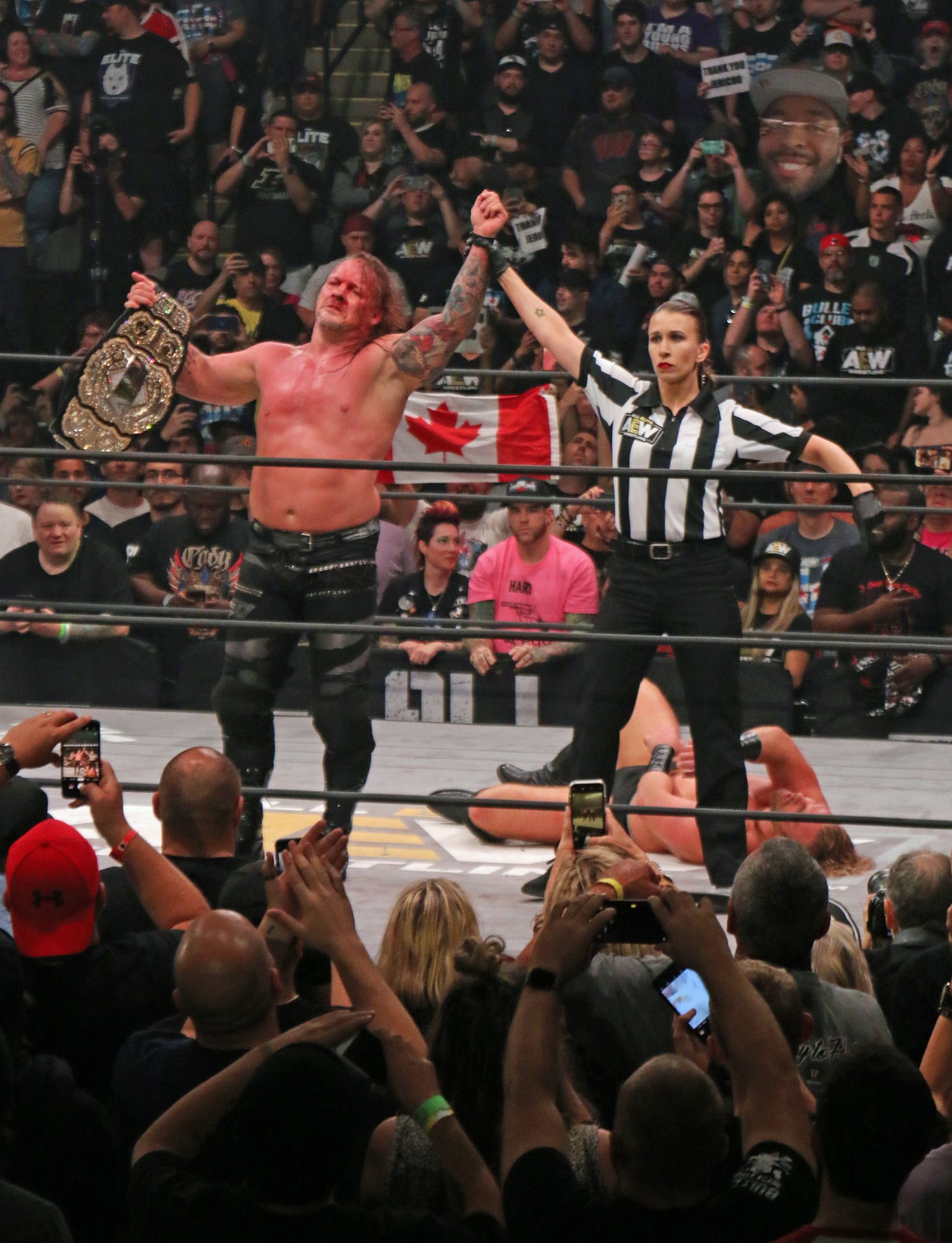
On August 31, 2019, All Elite Wrestling reached the point every new promotion eventually has to reach. It had to decide who would carry the company first.
That night at All Out, before a sold out crowd at the Sears Centre outside Chicago, Chris Jericho beat Hangman Adam Page to become the inaugural AEW World Champion. The finish was simple enough, Jericho caught Page with the Judas Effect and got the pin. The larger meaning was not simple at all.
AEW was only months old. It had already made noise with Double or Nothing, sold out major buildings on buzz alone, and convinced a lot of skeptical fans that it was more than a vanity project for disillusioned wrestling diehards. But a startup only feels real for so long on promise. At some point it needs a face, a pecking order, and a statement of intent.
Jericho becoming the first champion was that statement.
AEW needed a star who already felt proven
There was a real argument for Page going into the match. He was younger, fresh to a wider national audience, and clearly part of AEW's future. The company had also positioned him strongly, to the point that his entrance on horseback at All Out felt like a deliberate attempt to crown a new made man in front of the biggest possible audience.
But first champions are rarely about sentiment. They are about stability.
Jericho brought something AEW could not manufacture overnight. He was already a fully formed major league star, recognizable to lapsed viewers, credible to hardcore fans, and smart enough to understand exactly what a new promotion needed from its top title. He did not need the championship to become important. The championship needed him to make its first impression feel important.
That mattered even more because AEW was racing toward the launch of weekly television on TNT that October. A new company going national does not just need good wrestlers. It needs a central figure viewers instantly understand. Jericho had the name value, the presence, and the self-awareness to walk onto that first stretch of TV already feeling like the promotion's biggest act.
Contemporary Observer coverage made the logic plain: Jericho was the right champion to lead into television, and Page was better off as the man with room left to chase.
The match worked, even if the crowd had already seen chaos
The main event itself had an awkward job.
All Out was a loaded show. Earlier in the night, Pac upset Kenny Omega in a result that changed AEW's immediate direction. The ladder match between the Young Bucks and Pentagon Jr. and Fenix was the kind of violent spectacle that can leave any card gasping for air afterward. Santana and Ortiz also arrived after the ladder match, another reminder that AEW was trying to make this show feel like the start of something bigger rather than a one-night destination.
So when Jericho and Page finally got to the ring, they were not following a quiet undercard. They were trying to close a five-hour event that had already thrown a lot at the building.
That context matters, because the match is sometimes remembered more for what it represented than for how it played live. In the building, it had a tougher road because so much of the night's craziest action had already happened. Watched on its own, though, it was a strong title match with a clear purpose.
Page wrestled like a man trying to prove he belonged in that spot. Jericho wrestled like a veteran who understood that the first title bout in company history did not need to be a stunt show. It needed shape, control, and a finish the audience would remember. When the Judas Effect landed, it gave AEW a clean final image and gave Jericho a moment that instantly became part of the promotion's permanent history.
Why Jericho winning was better for Page too
One of the most interesting things about the decision is that it helped the loser almost as much as the winner.
If Page had won that night, he would have entered television as a first-time centerpiece carrying all the weight of proving he was ready. That can work, but it can also expose a younger star before the audience is fully invested. Losing to Jericho let Page leave All Out as a credible main event wrestler without forcing him to become the entire promotion at once.
That is a much easier position from which to grow. He had already been established as someone worth watching. He had stood in the biggest match on the card. He had carried himself like a future headliner. And because he lost to a star with Jericho's stature rather than falling out of contention entirely, the defeat could be used as a chapter in his rise instead of a dead end.
That is one reason the finish has aged well. AEW did not just pick the safer inaugural champion. It also avoided rushing Page into a role he would eventually fill far more effectively after the audience had more time to invest in him.
Jericho gave the belt an identity before TV even started
Inaugural champions always define more than a title lineage. They define tone.
By putting the belt on Jericho, AEW told viewers that its world championship scene would begin with a familiar name, but not as an act of nostalgia. Jericho was not there as a ceremonial legend collecting one last honor. He was there as an active top heel, still sharp enough to headline, still clever enough to generate attention, and still famous enough to give a new company extra gravity.
That attention came almost immediately in the strangest way possible. Within days, the new title belt was briefly stolen while Jericho was in Tallahassee after travel issues related to Hurricane Dorian, then recovered by police the next day. It was absurd, very wrestling, and somehow fitting. Even AEW's first championship reign began with noise around it.
But the real reason August 31, 2019 still matters is simpler. Every promotion remembers the moment its top prize became real. For AEW, that happened when Jericho pinned Page at All Out and turned a promising launch into a company with an actual champion, an actual top heel, and an actual direction.
A lot of wrestlers could have been part of AEW's foundation. On that night, Jericho was the one who made the foundation look solid.