
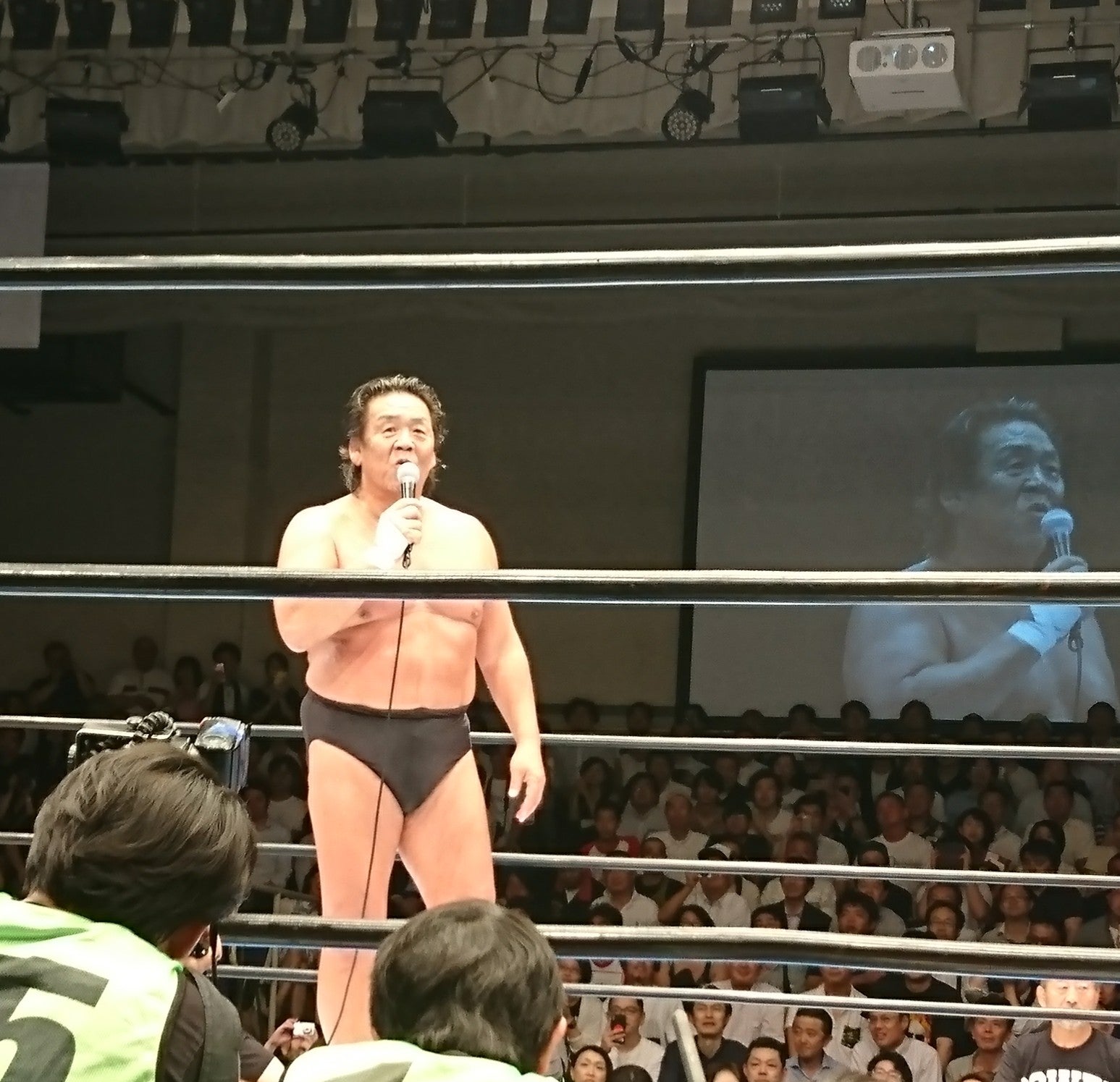
On June 26, 2019, Riki Choshu walked into Korakuen Hall for one last match, and Japanese wrestling got the kind of farewell that feels impossible to stage unless the man at the center of it really mattered.
The show was called Power Hall 2019: New Journey Begins, but the emotional truth was simpler than the branding. This was Choshu's final retirement, the second retirement of his career, and the one that finally carried the weight of an ending. Korakuen Hall sold out months in advance, the event was shown live in movie theaters around Japan, and the atmosphere sounded more like a generational gathering than a routine nostalgia card.
Choshu, 66 at the time, teamed with Shiro Koshinaka and Tomohiro Ishii in the main event, a six-man tag billed as The Final Rhapsody. Across from them were Tatsumi Fujinami, Keiji Muto and Togi Makabe, which meant the ring held multiple different eras of Japanese wrestling at once. When it was over, Makabe pinned Choshu with a King Kong kneedrop. It was the right kind of finish for a retirement match. Choshu went out on his back, with the result giving the moment the old-school finality it needed.
That date matters because Choshu was never just another decorated veteran taking a bow. He was one of the people who changed the shape of Japanese wrestling. Long before the retirement tributes, before the black trunks and white boots became such a familiar late-career image, he had already lived several different wrestling lives. He was an elite amateur wrestler, an Olympian, and then a pro whose toughness always felt different from everyone else around him.
Part of that edge came from his own history. Born to a Japanese mother and South Korean father, Choshu grew up facing discrimination and was not allowed to represent Japan at the 1972 Olympics despite winning his trials. He instead competed for South Korea. That background does not explain everything about the way he carried himself as a wrestler, but it helps explain why he never looked or felt like a conventional company man, even when he became one of the most powerful figures in the business.
His importance to pro wrestling was larger than titles, and he had plenty of those. Choshu became a defining star of the 1980s by helping turn Japanese-against-Japanese rivalry into the engine of major business. His break with Antonio Inoki's side, his wars with Tatsumi Fujinami, and the larger factional fights around him helped prove that domestic rivalries inside one promotion could feel every bit as hot as the old hero-versus-foreigner formula. That sounds normal now. At the time, it was a huge part of wrestling's evolution in Japan.
He mattered in another way, too. Choshu was not only a main-event wrestler, he was also a booking force. His later run in power helped shape New Japan's next generation, and contemporary coverage credited him with the creation of the G1 Climax in 1991. He also played a major role in elevating names like Shinya Hashimoto, Masahiro Chono and Keiji Muto, the trio who came to define a booming Dome era for the company. Plenty of stars leave behind memories. Fewer leave behind a different map for the business itself.
That is why the retirement show had such range to it. The undercard pulled in names and styles from multiple corners of the Japanese scene, and the main event felt deliberately symbolic. Choshu stood beside Koshinaka, another old rival turned fellow survivor, and beside Ishii, the disciple who carried some of Choshu's same blunt force and unsentimental intensity into a later generation. Across the ring were Fujinami and Muto, two men who had spent decades intertwined with Choshu's career, and Makabe, who was given the actual finishing responsibility.
The match itself was never going to be about workrate in the modern sense. It was about recognition. It was about the audience seeing familiar bodies, familiar faces and familiar signatures one more time, and understanding exactly what they were looking at. Even the date had resonance. Choshu's final match came on the 43rd anniversary of Antonio Inoki versus Muhammad Ali, one of the most famous Japanese wrestling dates ever. Whether you view that as intentional poetry or simply a striking coincidence, it added another layer of history to the night.
What made the show feel especially meaningful was that Choshu had already taught fans not to trust the word retirement too literally. His first retirement, the much bigger Tokyo Dome farewell in 1998, did not stick. He came back, worked again, booked again, left and returned again. That is part of wrestling. Retirement is often just another chapter heading. On June 26, 2019, though, the scale was different. This time the language around the show, the presentation, and the way the crowd treated it all suggested that everyone understood this was probably the real closing line.
There is something fitting about the fact that the final scene happened in Korakuen Hall rather than in a giant stadium. Choshu had already done the grand version. Korakuen gave this goodbye a more intimate kind of gravity. It put one of the most influential figures in Japanese wrestling history back in a room that felt close enough to touch, surrounded by peers, protégés and fans who knew exactly what he had meant.
By the end of the night, the result itself almost felt secondary. Yes, Makabe got the pin. Yes, Choshu finally lost the last match. But what June 26, 2019 really preserved was the sight of a wrestler whose influence stretched across generations being treated not like a museum piece, but like a living part of the industry's bloodstream right up to the end.
On this day, Riki Choshu did more than retire. He gave Japanese wrestling a final look at the man who helped harden its attitude, modernise its rivalries and shape the stars who followed him. That is why this date still lands with real force.