
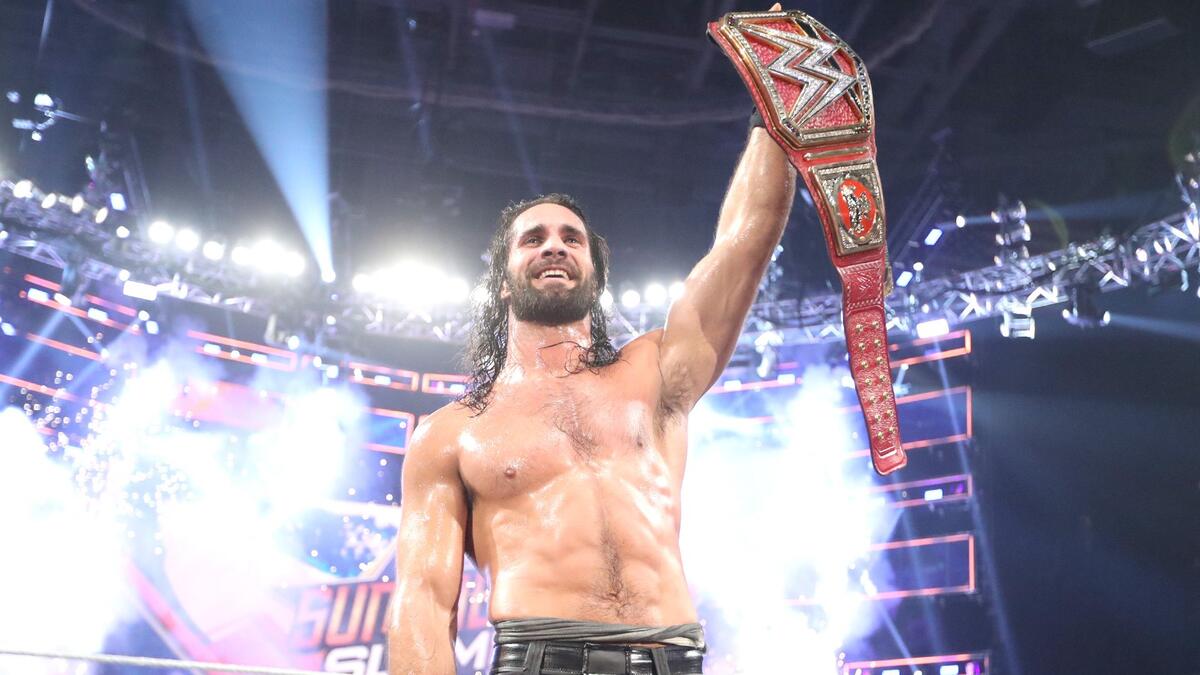
On August 11, 2019, WWE closed SummerSlam with something the company had not been especially good at delivering that year: a straightforward heroic payoff that people could feel in real time.
Seth Rollins beat Brock Lesnar in the main event at Toronto's Scotiabank Arena and won the Universal Championship for the second time. On paper, it was a rematch from WrestleMania 35, where Rollins had already toppled Lesnar once. In practice, it felt different. WrestleMania had been built around a trick, with Rollins using low blows to create the opening. SummerSlam was built around damage. Lesnar had spent weeks wrecking him, crushing his ribs, laughing off his chances and making the whole match feel like an execution date.
That framing mattered. Rollins did not walk into SummerSlam as a conquering ace. He walked in as a babyface WWE had been struggling to keep hot, opposite the one final boss the audience still accepted without question. The following Observer issue noted that Rollins had even dealt with boos during the weekend before the match. By the time the bell rang on Sunday night, he needed more than a title win. He needed a performance that reminded people why WWE had picked him for this spot in the first place.
Brock Lesnar had become the company's hardest mountain to move
Lesnar was not just champion in 2019. He was a booking atmosphere.
Whenever he held the Universal title, the rest of Raw bent around him. He did not have to be on television every week for the belt to feel locked in his orbit. That was part of his value. It was also part of the frustration. WWE wanted Lesnar to feel larger than everyone else, but that choice kept leaving the weekly show waiting for a part-time monster to show up and reset the table.
Rollins had been chosen earlier that year as the antidote. He won the Royal Rumble, slayed Lesnar at WrestleMania, and looked like the wrestler who was supposed to carry Raw into its next chapter. The problem was that WWE never fully stabilized that chapter. Rollins had to work through uneven reactions, a rough feud with Baron Corbin, and the sense that the company was still more comfortable leaning on Lesnar than building around the man who beat him.
That is what made SummerSlam feel bigger than a routine rematch. If Lesnar won, the old gravity returned. If Rollins won clean, then WWE had finally committed to the idea that its full-time star could stand up to the monster without shortcuts.
Seth Rollins won by surviving, then attacking all at once
The match itself succeeded because it never pretended Rollins was Lesnar's physical equal. Instead, it asked whether speed, timing and refusal could overwhelm a champion who thought brutality alone would finish the job.
Rollins jumped him early with a Stomp, then kept moving. He fired off superkicks, threw himself into dives and kept the pace jagged enough that Lesnar could never fully settle into his usual rhythm. Lesnar still looked terrifying whenever he got control. He threw Rollins around, punished the injured ribs and turned the match into the kind of beating that makes a crowd wait for the exact second hope is supposed to die.
But Lesnar made the mistake that great monster champions often make. He lingered.
He treated punishment as performance. Instead of finishing the challenger the moment the opening appeared, he played with him, dragged him around and left just enough daylight for Rollins to keep believing. Once Rollins escaped near the announce table and crashed Lesnar through it with a frog splash, the match stopped being about whether he could survive and started being about whether Lesnar had already missed his chance.
The ending landed because it was both dramatic and simple. Rollins avoided the F-5, hit another superkick, drove Lesnar down with a final Stomp and got the three-count. No ref bump. No low blow. No screwy escape hatch. WWE let its top full-time babyface beat Brock Lesnar clean in the middle of the ring at SummerSlam.
That was the whole point.
What Seth Rollins' SummerSlam win fixed, even if only for a night
Rollins' victory did not solve every creative problem around Raw, and history makes that easy to see. WWE would continue to wobble between long-term ideas, and Rollins' own presentation would keep changing over the next several years. But on that specific night, the company got the emotional math right.
Lesnar had spent months representing the version of WWE that trusted scarcity, aura and destruction above all else. Rollins represented the opposite model, the full-time star who had to sell the injuries, carry the television burden and make people come back next Monday. A clean Rollins win was WWE admitting that this version of the company still needed heroes who actually feel rewarded for enduring the grind.
It also helped SummerSlam 2019 breathe as a turning-point show. Earlier in the night, Bray Wyatt had unveiled The Fiend in a devastating win over Finn Balor. Kofi Kingston retained the WWE Championship against Randy Orton when their grudge spilled past the referee's control. Kevin Owens saved his job by beating Shane McMahon. The show had movement to it. Rollins beating Lesnar gave that movement a real ending rather than an asterisk.
That is why the image that lasts is not just the belt change. It is the release in the building when people realized WWE was not going to pull the rug away at the last second. Rollins was bruised, exhausted and still standing. For one night, that was enough to make the entire company feel less cynical.
SummerSlam has always worked best when it feels like WWE's big summer answer, not just a placeholder on the road to the next stadium season. On August 11, 2019, Rollins and Lesnar gave it that answer. WWE had spent months making Brock Lesnar feel unbeatable. The important part was not that Seth Rollins proved he was stronger. It was that he proved a full-time star could still beat the system's favorite monster without flinching, without cheating, and without the moment shrinking under him.
That was not a permanent cure for everything around WWE in 2019. It was something rarer in the moment, a finish fans could accept, believe and enjoy without qualification.
Also on this date, Tetsuya Naito won the 2013 G1 Climax by beating Hiroshi Tanahashi in the final, and Kenny Omega's 2018 G1 meeting with Kota Ibushi turned Budokan Hall into one of New Japan's loudest modern stages. August 11 has not lacked for major wrestling nights. Rollins beating Lesnar belongs on that list because of how badly WWE needed a victory that felt clean, decisive and earned.