
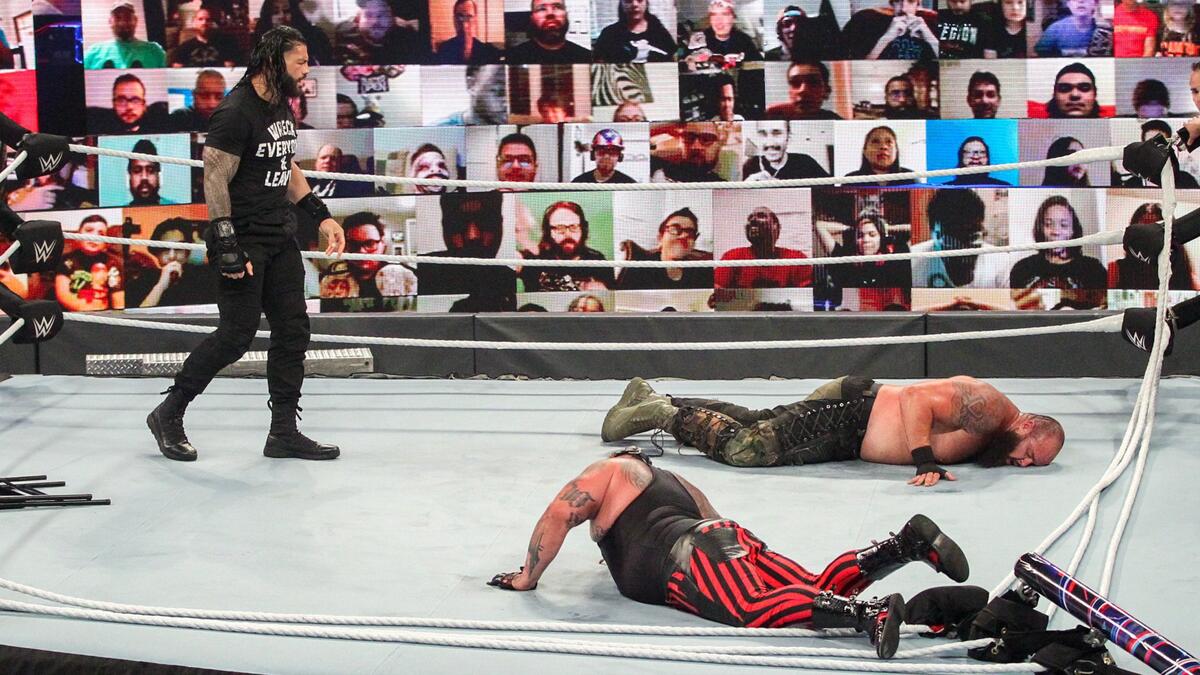
On August 30, 2020, WWE finally stopped fighting the version of Roman Reigns that so much of its audience had been asking to see for years.
Reigns walked into Payback after months away, stood beside Paul Heyman, entered the Universal title match on his own terms, and left with the championship. The moment was chaotic, opportunistic, and a little shameless. That was exactly why it worked.
In hindsight, this was not just a title change at the WWE ThunderDome in Orlando. It was the night Reigns stopped being the company\'s hand-picked lead babyface and became the cold, calculating star the role had always hinted at. The version of Reigns that emerged from Payback would go on to anchor WWE for years, lead the Bloodline story, and turn one of the company\'s most debated top acts into one of its most effective.
The return already felt different before the bell rang
Reigns had been out of action since the early pandemic stretch, stepping away amid COVID-19 concerns after being lined up for one of WWE\'s biggest matches of the year. By the time he reappeared at the end of SummerSlam a week earlier, the surprise mattered, but the tone mattered even more.
He did not come back as a grateful hero reclaiming his place. He came back with edge. He destroyed both Braun Strowman and the newly crowned Fiend Bray Wyatt, and the attack landed less like a comeback celebration and more like a warning that the top of the card was about to be reorganized around him.
That setup gave Payback an unusual kind of tension. WWE had only just moved into the ThunderDome, still figuring out how to make pandemic-era wrestling feel major, and suddenly it had a main event built around uncertainty. Reigns was in the match, but even that came with a catch. He spent the final SmackDown before the show making it clear that he was not playing by the usual rules, punctuating the angle with the line that his title win would be a spoiler rather than a prediction.
Then the camera revealed Heyman sitting beside him.
That shot did a huge amount of work all at once. Reigns had spent years pushed as the successor to John Cena, often in open tension with fans who wanted him presented differently. Pairing him with Heyman instantly told viewers that this was not another attempt to force the same act back into place.
Paul Heyman changed the meaning of Roman Reigns overnight
The smartest part of the turn was that WWE did not ease into it. It made the shift obvious.
Contemporary Observer coverage noted that Reigns had wanted the heel turn on his return, and whether the call came from him, Vince McMahon, or both, the result was the same. WWE finally embraced the arrogance, control, and menace that had always sat closer to Reigns\' natural star presence than the smiling-company-ace presentation ever did.
Heyman was the perfect shortcut into that new version. With Brock Lesnar out of the picture, Heyman gave Reigns an instant layer of strategy and danger. He was no longer just the physically dominant star. He was now the star who had a fixer, a spokesman, and a system built to tilt the board in his favor.
That is what made the turn feel bigger than a simple villain switch. Reigns was not suddenly acting evil for the sake of it. He was acting entitled. He behaved like the championship scene already belonged to him, and everyone else was just temporarily holding his property.
The company had flirted with shades of that idea before, but Payback was the first time it committed to the full version. Reigns was not asking to be cheered. He was demanding control.
The match was messy, but the mess was the whole point
Payback\'s main event was a no holds barred triple threat for the Universal Championship with Wyatt defending against Strowman and Reigns. The structure itself told the story.
Reigns did not even start the match. Wyatt and Strowman fought first while Reigns waited. Late in the bout, after a superplex spot collapsed the ring, Reigns finally made his entrance, signed the contract at ringside, and told Heyman to produce a referee. It was a brazen bit of gamesmanship, the kind of move a top heel makes when he assumes the rules are flexible as long as he is the one bending them.
From there, the finish leaned fully into ugliness. Reigns blasted Strowman with repeated chair shots, escaped Wyatt\'s mandible claw with a low blow, speared Strowman, and took the pin to win the title. It was not noble, and it was not designed to be.
That finish mattered because it rejected almost every old Roman Reigns instinct at once. This was not a hard-fought triumph built around resilience and respect. It was a power grab. Reigns picked his moment, exploited the wreckage around him, and made sure the belt changed hands in the least generous way possible.
Even the match\'s uneven quality helped the larger moment. Nobody remembers Payback 2020 as a technical masterpiece. They remember it as the night the character snapped into place. The layout, the delayed entrance, the contract signing, Heyman at ringside, the chair shots, all of it served the same goal. WWE was not trying to give Reigns a feel-good return. It was trying to show that he now operated above the usual moral code.
Why Payback 2020 changed WWE for years
Some turning points feel historic in the moment. Others only reveal their size later. Payback 2020 managed to be both.
Reigns\' title win that night became the start of a 1,316-day Universal Championship reign, the longest in that title\'s history and one of the defining world title runs WWE has ever built in the modern era. More importantly, it gave the company a top star whose presentation finally matched his strengths. Instead of swimming against crowd reactions, WWE turned those old tensions into the foundation of the character.
That changed the entire shape of SmackDown. It changed how Paul Heyman was used. It opened the door to Jey Uso's role in the story, then to the full Bloodline saga that would dominate WWE television. None of that was fully formed on August 30, but the engine started there.
It also gave the ThunderDome period one moment that still feels essential outside the strange conditions of that year. Pandemic-era wrestling produced plenty of oddities and necessary compromises. Reigns at Payback was different. That was not a workaround. That was WWE finding a better version of its biggest star under pressure.
On this day in 2020, Roman Reigns did more than win the Universal Championship. He took the act WWE had spent years trying to protect, stripped away the parts that never fit, and turned it into the performance that would define the next era of the company.