
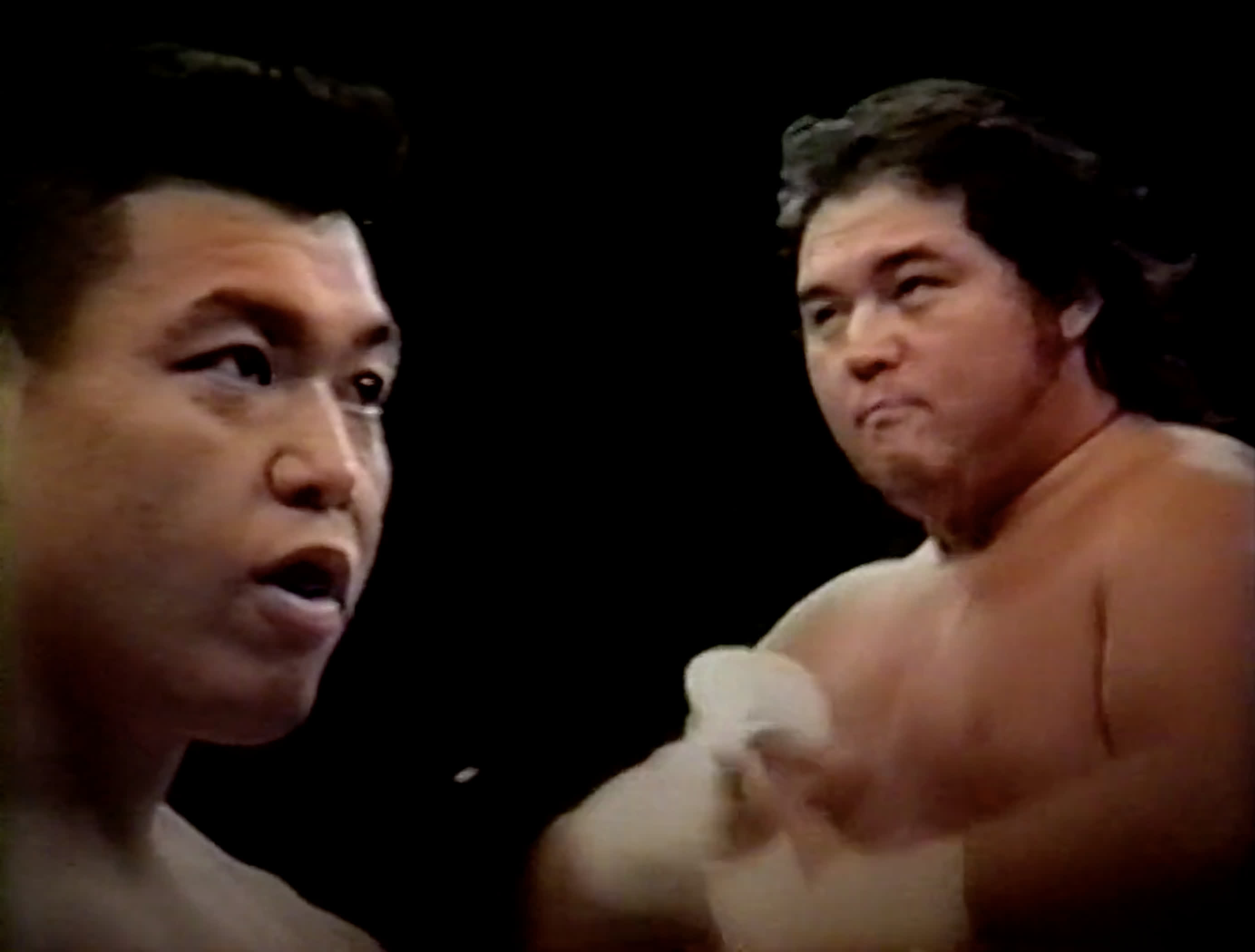
On April 12, 1997, New Japan put one of its biggest stars in the ring at the Tokyo Dome and let chaos take over.
Shinya Hashimoto was not just another champion walking into a title defense. He was one of the defining figures of 1990s New Japan, a bruising main event force who represented the promotion's toughness better than almost anyone. The idea that he could be seriously threatened by a man making his professional wrestling debut sounded absurd on paper.
Then Naoya Ogawa walked in and beat him.
That was the shock at the heart of Battle Formation 1997. Ogawa arrived with real combat credibility as an Olympic silver medalist in judo, but this was still supposed to be a wrestling super show built around New Japan's biggest stage, not an open invitation for an outsider to upend the house in a single night. Instead, that is exactly what happened. Ogawa replaced the originally planned Ken Shamrock in the main event, faced the reigning IWGP Heavyweight Champion in a non-title different style fight, and left the Dome with one of the most jarring upset wins the company had ever staged.
What made the result hit so hard was who Hashimoto was in that moment. He was not fading, protected by nostalgia, or being used to make a young lion look respectable. He was the man. New Japan had spent years building him as one of its pillars, one-third of the Three Musketeers generation, and one of the clearest symbols of the company's identity. When a wrestler at that level loses to a debutant, it is not just a finish. It is a statement that the normal rules no longer apply.
The Observer's coverage of the feud later pointed back to that first meeting as the moment Ogawa became an instant star. That feels exactly right. Wrestling promotions spend years trying to manufacture the kind of aura Ogawa created in one night. He did not climb the ladder the usual way. He skipped the ladder. By beating Hashimoto in his first match, he was immediately positioned as something disruptive, dangerous and impossible to treat like a conventional rookie.
That was the genius and the risk of the angle. New Japan was leaning into the blurry line between pro wrestling and legitimate combat that had become one of the defining tensions of the era. Hashimoto, for all his charisma and star power, was now being forced into that tension against an opponent whose selling point was not polish or ring experience but credibility. Ogawa did not have to look like a finished wrestler. In some ways, it helped that he didn't. He felt like an intruder from another world, and the discomfort that created was part of the draw.
The Tokyo Dome was the perfect setting for a gamble like that. New Japan never thought small when it came to presenting Hashimoto, and the Dome crowd gave the match a scale that turned the result from surprising to historic. Once Ogawa won, it was obvious this could not be treated as a one-off attraction. A line had been crossed. Hashimoto had been embarrassed on the biggest stage available, and a champion built on pride and physical dominance was now tied to a rival who represented disorder more than hierarchy.
That is why the match mattered beyond the upset itself. April 12, 1997 did not simply introduce Naoya Ogawa as a new name. It changed the direction of one of New Japan's most important rivalries of the late 1990s. Their feud became one of the most famous and volatile programs of the period, fueled by the sense that it was never fully safe, never entirely clean and never comfortably contained inside standard wrestling logic. Fans did not just want to see who would win next. They wanted to see what would happen when control broke down again.
There was also something revealing in the way the result reframed Hashimoto. Great stars are often defined as much by the defeats that wound them as by the victories that crown them. Hashimoto had built his reputation as a destroyer, but the Ogawa rivalry forced him into a different role. He became the establishment ace trying to defend the promotion's order against a man who did not care about tradition or proper progression. That gave the feud a deeper emotional pull than a simple champion-versus-challenger story. Hashimoto was fighting for pride, for status, and in a lot of ways for New Japan's own self-image.
For Ogawa, the upset created a career-long myth in a single stroke. Plenty of wrestlers debut with hype. Very few debut by beating the reigning ace in front of a massive Tokyo Dome crowd. That kind of booking can backfire if the audience rejects it, but this one stuck because it spoke directly to the mood of the time. Japanese wrestling in the 1990s was fascinated by realism, credibility and collision. Ogawa embodied all of that before he had ever learned the rhythms of being a traditional pro wrestler.
Looking back now, the result still feels bold. Promotions talk all the time about making stars, but they often retreat the second a decision might unsettle the hierarchy. New Japan did not retreat on April 12, 1997. It detonated its own main event structure in public and trusted the fallout to carry the story forward.
It did. The rematches, the heat and the lasting reputation of the Hashimoto versus Ogawa rivalry all trace back to that first Tokyo Dome shock. On the day itself, though, fans did not need to know the whole future to understand they had seen something major. An outsider had arrived, the ace had fallen, and New Japan suddenly looked like a more dangerous place.
That is why the date endures. Not because it was a polished classic, and not because it fit neatly into wrestling convention, but because it felt like the moment the ground shifted. On April 12, 1997, Naoya Ogawa did not simply debut. He crashed through the front door of New Japan and dragged one of its biggest stars into a feud the company could never pretend was ordinary.