
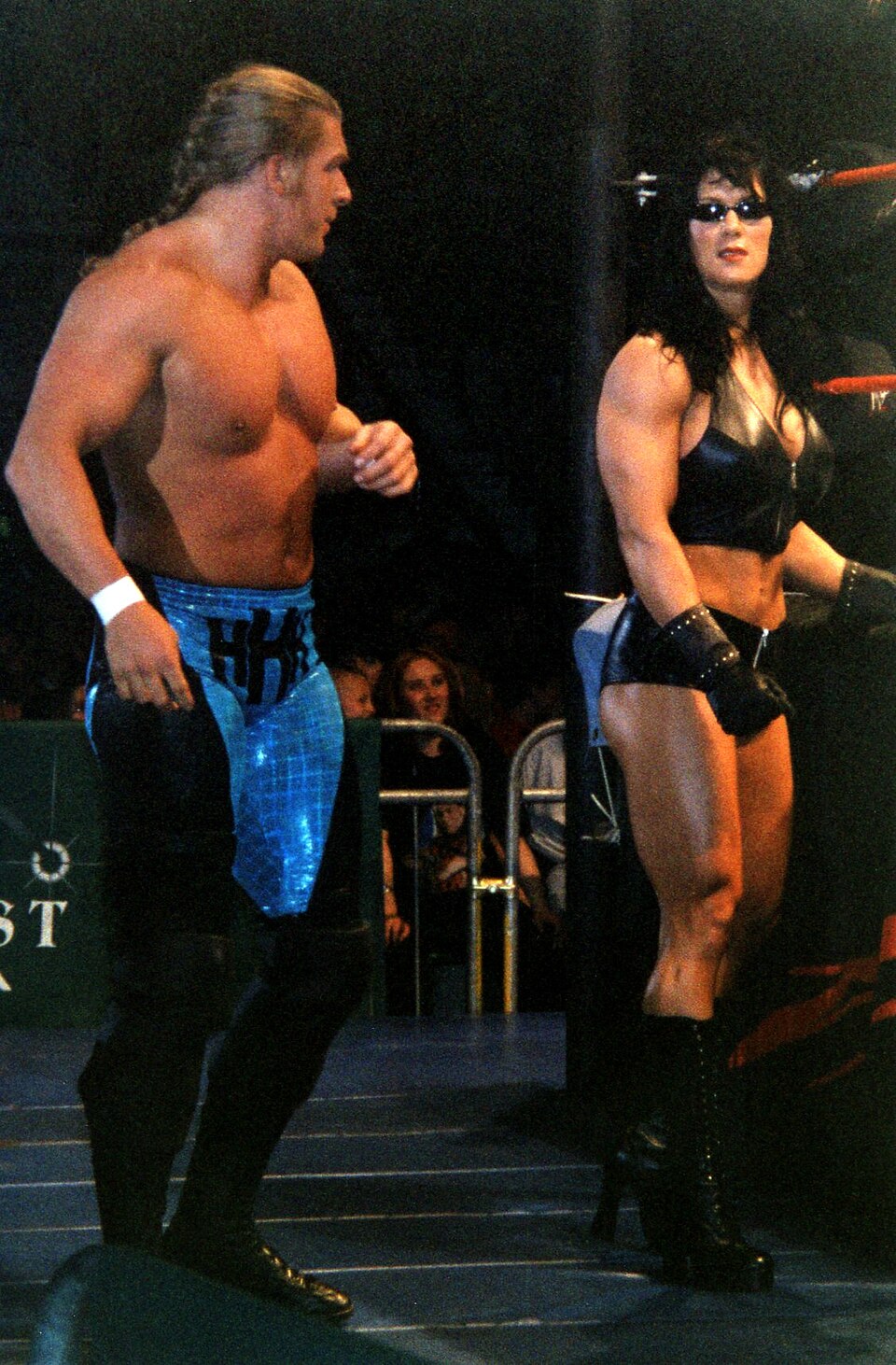
On April 20, 2016, Joanie Laurer was found dead at her home in Redondo Beach, California. She was 46. For wrestling fans, the shock was not only that Chyna was gone so young. It was that one of the defining stars of wrestling's hottest modern boom period had died while still feeling strangely unresolved, admired by generations of fans, celebrated as a pioneer, yet never fully fitted into the official story of the era she helped shape.
That tension had followed her for years, because Chyna never fit neatly into the role the business usually assigned women. She arrived in WWE as something different altogether. As the intimidating force standing beside Shawn Michaels and Triple H in the early days of D-Generation X, she was not presented as eye candy, a valet or a sideshow. She was introduced as power. She was there to change the balance of a segment the moment she stepped into frame, and fans bought it immediately.
That was the breakthrough. Chyna did not become famous because promoters told audiences to admire her for being groundbreaking. She became famous because she looked and carried herself like someone who belonged in fights that women had almost never been allowed to occupy on national wrestling television. In the Attitude Era, when everything was louder, cruder and built to grab attention fast, she still managed to feel genuinely new. Plenty of performers were edgy. Almost nobody felt unprecedented.
Her list of firsts still reads like a challenge to the limits WWE had once placed on women. She became the first woman to enter the Royal Rumble. She became the first woman to qualify for the King of the Ring tournament. Most famously, she became the first, and still only, woman to hold the Intercontinental Championship, a title long treated as part of the men's ladder to main event status. Those were not token achievements handed out to manufacture headlines. They landed because fans had already accepted the basic idea that Chyna could credibly stand in the same ring as the men around her.
That credibility was the real achievement. Wrestling has had women stars in every era, long before Chyna and long after her. What made her stand out was that she shifted the framing. She was not simply a top woman in a separate lane. She was presented as someone who could break into the lane itself. That mattered, and it still matters, because even now it is rare to find a performer who changes the imaginative boundaries of wrestling rather than just succeeding inside them.
Contemporary Observer coverage of her death captured how large she had once loomed, describing her as one of the most recognizable figures from wrestling's last great period of mainstream saturation. That is exactly right. Chyna was not a cult favorite remembered only by devoted tape traders or Attitude Era nostalgists. She was one of the faces of a national craze. Even people who barely followed the week-to-week product often knew who the Ninth Wonder of the World was.
There is also an uncomfortable truth inside her legacy. The business did not really know how to build on what she opened. WWE would later produce major female stars, and eventually a far deeper women's division than the one Chyna worked in, but her specific lane was never truly recreated. For a while, it almost felt as if the industry had proven her concept worked and then stepped away from it. That says something about how singular she was. Chyna was not the beginning of an immediate revolution in presentation. She was a rupture, a performer so unusual that wrestling could profit from her without fully understanding how to make her a lasting model.
That helps explain why her story could feel both triumphant and sad at the same time. The highs were enormous. She crossed over into mainstream celebrity, posed for Playboy, became one of the company's most recognizable personalities and built moments that still stand out in any recap of late 1990s wrestling. But the years after her WWE run were far more uneven, and by the time of her death, public discussion of Chyna often carried an undertone of regret about how little peace she seemed to have found after the spotlight moved on.
That is why April 20, 2016 still hits so hard. It was not only the death of a famous wrestler. It was the loss of a figure who represented both the possibilities and the costs of wrestling's most combustible era. Chyna had the look, the charisma and the timing to break rules that had stood for decades. She also carried the weight of being treated as exceptional in a business that is often far less generous once the moment changes.
Her place in history has only become firmer since then. WWE eventually inducted D-Generation X into the Hall of Fame in 2019, with Chyna included posthumously, and that recognition mattered because it acknowledged what fans had been saying for years. She was not a side note to that act or that period. She was essential to it. More than that, she remains a reference point any time wrestling tries to present a woman as something more than a division, an archetype or a market category.
That is Chyna's real legacy. She made the industry think bigger about who could look dangerous, who could look important and who could be believable in spaces that had long been reserved for men. On April 20, 2016, wrestling lost a star. It also lost one of the rare performers who permanently widened the frame of the business.